Open-Cell vs. Closed-Cell Application Techniques
Open-cell and closed-cell SPF are chemically different products that behave differently under the gun. Closed-cell's higher density and faster rise mean tighter exotherm and lift-thickness limits per pass; open-cell's lower density is more forgiving on pass thickness but has different moisture and vapor-permeability behavior that affects where it's an appropriate choice.
This course assumes SPF Application Fundamentals as a prerequisite and goes deeper into the specific technique adjustments each system requires — it does not re-teach basic gun handling.
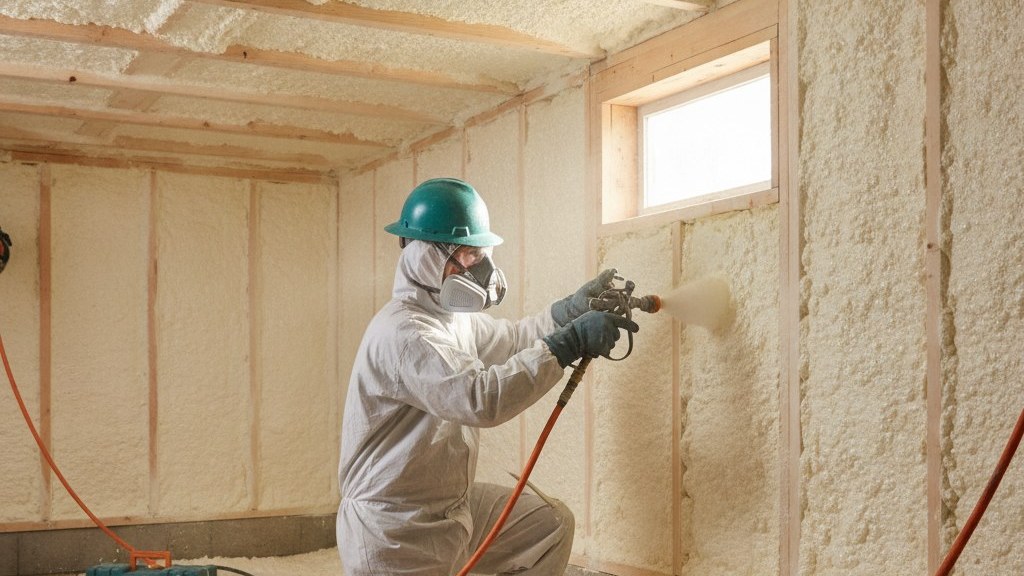
- Applicators who've completed the fundamentals course and are ready to work confidently with both systems
- Crews that currently only spray one system and want to add the other to their service offering
- Anyone earning the Certified SPF Applicator credential, which requires competency in both systems
- Density, R-value per inch, and vapor-permeability differences between open-cell and closed-cell systems
- Maximum pass (lift) thickness guidance for each system and why closed-cell's exotherm risk is the limiting factor
- Where each system is the more common technical choice: closed-cell for rim joists, below-grade, and exterior wall assemblies where a vapor retarder and structural racking value matter; open-cell for interior cavities and sound-dampening applications where vapor openness is wanted
- Substrate and climate considerations that affect which system is specified on a given job
- Technique adjustments: gun distance, pass speed, and pattern differences between the two systems
Why this is its own course
A lot of applicators learn one system well and treat the other as 'the same gun, different chemical.' It isn't. Closed-cell's faster reactivity and higher exotherm mean a pass thickness that's safe on open-cell can overheat closed-cell foam, risking scorching, off-gassing, or a fire-safety issue on the substrate. This course exists specifically to correct that gap before it becomes a job-site problem.
Hands-on comparison lab
Students spray both systems side-by-side on matched training substrate in the same session, so the technique differences are felt directly rather than described abstractly.
- Closed-cell pass-thickness limits demonstrated with temperature monitoring
- Open-cell full-cavity fill technique and trim-back preparation
- System selection walk-through for common assembly types (rim joist, exterior wall, interior partition, roof deck)
SPF Application Fundamentals
Counts toward the Certified SPF Applicator credential (required core course).
See how certification works for the full credential requirements.
Open-Cell vs. Closed-Cell Techniques FAQs
Yes — most students in this course already have hands-on experience with one system. The value is in the structured comparison and the technique adjustments for the system you don't spray as often, plus the credential documenting that competency.
It covers the general technical tradeoffs (vapor permeability, R-value per inch, structural racking value for closed-cell) so students understand why a system gets chosen, but final specification on a real project should follow the project's engineering requirements and local code.
Other courses in the curriculum
SPF Application Fundamentals
The entry point into the curriculum — SPF chemistry basics, substrate preparation, spray gun technique, and pass control for consistent, code-compliant lift thickness.
Read moreRig Operation & Maintenance
Covers the equipment side of the trade — proportioner operation, heated-hose management, daily start-up and shutdown procedures, and the preventive maintenance that keeps a rig from becoming a mid-job breakdown.
Read moreEstimating & Quality Control
The course that connects technical application skill to job profitability — accurate square-footage and board-foot estimating, real-world yield vs. theoretical yield, and a quality-control process that catches problems before the customer does.
Read moreStart your certification path
Tell us which courses you're interested in and where you're at, and we'll follow up with the next available cohort — in-person or online.