SPF Application Fundamentals
SPF Application Fundamentals is the first course in the Spray Foam Institute curriculum and the prerequisite for every other technical course. It's built for two kinds of students: people entirely new to spray polyurethane foam who need a structured starting point, and experienced crew members who have learned by watching but have never gone through a formal course covering the fundamentals in order.
The course treats SPF application as a teachable, repeatable skill rather than something picked up by trial and error on a paying job. Students leave with a working understanding of two-component SPF chemistry, how to read a substrate and job site before spraying, and the hands-on gun control needed to lay consistent passes at the intended thickness.
- New hires and career-changers with little or no prior SPF experience
- Helpers who want to move up to applicator
- Experienced applicators who never had formal training and want a credential that reflects their skill
- Business owners who want a consistent onboarding standard for every new crew member
- How two-component (A-side isocyanate / B-side resin) SPF chemistry works and why ratio control matters
- Open-cell vs. closed-cell systems at a basic level — density, R-value per inch, and where each is typically used
- Substrate inspection and preparation — moisture, temperature, and surface conditions that affect adhesion
- Proper gun handling, pass technique, and lift thickness control to avoid off-ratio foam and excessive exotherm
- Reading a yield chart and understanding why installed thickness is checked, not assumed
- Basic troubleshooting — identifying shrinkage, poor adhesion, and off-ratio foam before it becomes a callback
Why formal application training matters
SPF is a chemical process, not just a spray coating. Ratio, temperature, and pass thickness all affect the finished product's performance and safety — get any of them wrong and the result can be under-cured foam, excessive heat buildup, poor adhesion, or foam that doesn't perform to its rated R-value.
This course exists because most SPF applicators historically learned entirely on the job, standing next to someone more experienced. That model works, but it produces uneven results across a crew and leaves gaps that only show up later — usually on a callback or an inspection. A structured fundamentals course gives every student the same baseline before they're handling a rig on a live job.
What the hands-on lab covers
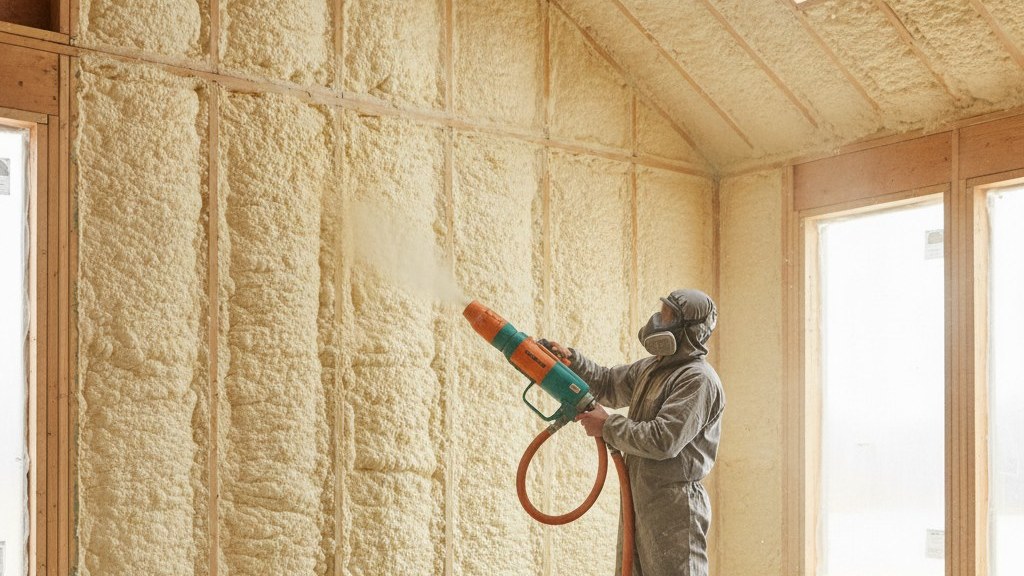
The in-person lab portion puts students behind a rig on training substrate — framed wall sections and mock attic decking — under direct supervision. Students practice gun distance, pass overlap, and pace until they can lay a consistent, properly cured lift without coaching.
- Rig start-up, pressure and temperature checks before spraying
- Test-pattern spraying and visual/tactile evaluation of the result
- Multi-pass technique on vertical and overhead (ceiling/roof deck) substrates
- Identifying and correcting common defects in real time: fisheyes, shrinkage, delamination
Online / self-paced format
Students who can't attend the full in-person format complete the chemistry, safety-overview, and technique modules online at their own pace, then schedule a single hands-on lab day to complete the course and demonstrate application competency in person. The credential requires the in-person lab component regardless of format — this course does not offer a fully remote certification path, because gun control is a physical skill that has to be demonstrated.
None. This is the entry point to the technical track.
Counts toward the Certified SPF Applicator credential (required core course).
See how certification works for the full credential requirements.
SPF Application Fundamentals FAQs
No. This course is written for students with zero SPF experience, though experienced applicators without formal training take it too, specifically to fill that gap and earn a documented credential.
The lecture and chemistry modules are available online, but the credential requires an in-person hands-on lab day where you demonstrate gun control and pass technique on training substrate. Application skill has to be shown, not just read about.
Work clothes you don't mind getting foam overspray on, closed-toe boots, and eye protection if you have your own. PPE for the spraying itself is provided for the training environment; your own respirator fit-testing is covered separately in the OSHA Safety & Compliance course.
Other courses in the curriculum
Open-Cell vs. Closed-Cell Techniques
Builds directly on the fundamentals course to cover the real technique differences between open-cell (0.5 lb) and closed-cell (2 lb) systems — where each gets used, and how the spray technique itself changes between them.
Read moreRig Operation & Maintenance
Covers the equipment side of the trade — proportioner operation, heated-hose management, daily start-up and shutdown procedures, and the preventive maintenance that keeps a rig from becoming a mid-job breakdown.
Read moreOSHA Safety & Compliance
A required course for every credential track — the OSHA standards that actually apply to an SPF job site: respiratory protection, PPE, hazard communication, and isocyanate exposure control, taught by what a crew needs to know and document, not a general-industry lecture.
Read moreStart your certification path
Tell us which courses you're interested in and where you're at, and we'll follow up with the next available cohort — in-person or online.