Rig Operation & Maintenance
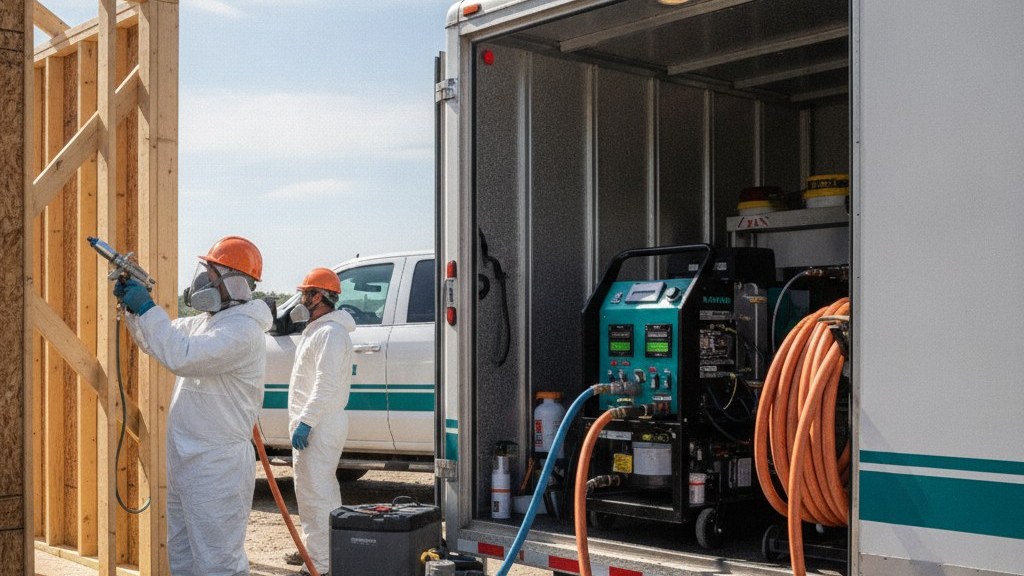
A spray rig is a significant capital investment and the single point of failure for a crew's entire day if it isn't run and maintained correctly. This course is built for applicators and crew leads who are responsible for setting up, running, and maintaining a proportioner and heated-hose system — not just pulling the trigger on the gun.
Rig problems on a job site are expensive in two ways: lost production time, and off-ratio foam caused by equipment that's out of calibration. This course treats equipment competency as its own skill, separate from spray technique.
- Applicators moving into a crew-lead or lead-technician role
- Owner-operators who run their own equipment
- Anyone responsible for daily rig start-up, shutdown, and basic field maintenance
- Proportioner components and how heated-hose temperature and pressure settings affect ratio control
- Daily start-up sequence, including drum changes, filter checks, and pre-spray ratio verification
- Heated-hose care — coiling, storage, and the damage patterns that come from improper handling
- Preventive maintenance schedule: what gets checked daily, weekly, and at manufacturer-recommended service intervals
- Field troubleshooting for the most common rig issues: pressure imbalance, temperature drift, and gun clogging
- End-of-day shutdown and off-season storage procedures
Equipment competency as its own discipline
It's possible to be a skilled applicator and still not fully understand the equipment producing the material coming out of the gun. This course separates those two skill sets deliberately. Students who complete it can diagnose whether a quality problem in the foam is a technique issue or an equipment issue — a distinction that saves significant time and material on a real job site.
Preventive maintenance, not just repair
Most costly rig downtime is preventable. This course puts weight on the maintenance schedule — the parts that wear predictably and the checks that catch a developing problem before it causes a mid-job shutdown — rather than only covering how to react once something has already failed.
- Daily pre-spray checklist (filters, ratio check, hose inspection)
- Weekly maintenance items and what they're checking for
- Manufacturer-interval service items and why skipping them is expensive later
- Basic field fixes vs. issues that require a qualified technician
SPF Application Fundamentals recommended but not required — this course can be taken by crew leads who don't do the spraying themselves.
Counts toward the Certified SPF Applicator credential (required core course).
See how certification works for the full credential requirements.
Rig Operation & Maintenance FAQs
No. Any crew lead or senior applicator who's responsible for daily rig operation benefits from it, even on a rig owned by the company rather than personally.
The course covers proportioner and heated-hose systems at the level of principles common across major manufacturers — pressure, temperature, ratio control, and maintenance intervals. Students should also follow their specific manufacturer's documentation for model-specific settings.
Other courses in the curriculum
SPF Application Fundamentals
The entry point into the curriculum — SPF chemistry basics, substrate preparation, spray gun technique, and pass control for consistent, code-compliant lift thickness.
Read moreOpen-Cell vs. Closed-Cell Techniques
Builds directly on the fundamentals course to cover the real technique differences between open-cell (0.5 lb) and closed-cell (2 lb) systems — where each gets used, and how the spray technique itself changes between them.
Read moreEstimating & Quality Control
The course that connects technical application skill to job profitability — accurate square-footage and board-foot estimating, real-world yield vs. theoretical yield, and a quality-control process that catches problems before the customer does.
Read moreStart your certification path
Tell us which courses you're interested in and where you're at, and we'll follow up with the next available cohort — in-person or online.